






Key Takeaways:
-
Large-breed puppies are the one group where feeding more can cause lasting harm, because growth rate and calcium intake both influence skeletal development.
- AAFCO sets a calcium maximum, not just a minimum, for foods intended for large-size growth, which is why a general puppy formula is not automatically suitable.
- A 14-year study of 48 Labradors found lean-fed dogs lived a median 1.8 years longer and needed osteoarthritis treatment around three years later than their pair-matched littermates.
-
Large breeds reach skeletal maturity closer to 18 to 24 months, so they stay on growth feeding longer than small breeds do.
- Keeping a large dog lean is better evidenced than any supplement on the market.
A 30kg dog is not a 6kg dog scaled up. That is true of the skeleton carrying the weight, the joints absorbing it, and the timeline over which all of it develops.
Which makes choosing dog food for large breeds in India one of the few areas of dog nutrition where the decisions genuinely differ by size rather than just by portion. And where the most common mistake, feeding a growing puppy generously, is the one that causes the most lasting damage.
Here is what changes at each stage, what the evidence supports, and where to find the guidance specific to your breed.
Why large breeds are a different feeding problem

Three things separate them:
-
Growth is longer and steeper: A large-breed puppy multiplies its birth weight many times over, across 18 to 24 months rather than the eight to 12 months a small breed takes. More growing, over more time, means more opportunity for something to go wrong
-
Joints carry more load: Every kilogram of excess weight is absorbed by hips, elbows, and stifles that were already under more strain than a small dog's
-
Calorie needs do not scale linearly: A dog twice the weight of another does not need twice the calories, because energy requirement scales with metabolic body weight rather than total body weight. Portioning a large dog by eye usually overfeeds
Feeding large-breed puppies, roughly two to 18 months

Puppyhood is the stage that matters most, and the one where generosity backfires.
Two variables carry most of the risk: how fast the puppy grows, and how much calcium it takes in. Excess energy intake and excess calcium during growth are both recognised contributors to developmental orthopaedic disease, a group of conditions that includes hip and elbow dysplasia, osteochondrosis, and hypertrophic osteodystrophy.
The mechanism is worth understanding. A growing puppy cannot regulate calcium absorption well, so a diet carrying too much of it does not simply pass through. And a heavy, fast-growing puppy loads an immature skeleton before it is ready.
What this means practically:
-
Calcium has a ceiling, not just a floor: AAFCO sets a maximum calcium level for foods intended for the growth of large-sized dogs, precisely because excess is a recognised risk. A general-purpose puppy food can legally carry more calcium than suits a large-breed puppy
-
Do not add calcium supplements: Unless a vet has specifically directed it, for a puppy on a complete diet, supplementing is the easiest way to overshoot
-
Feed measured meals, not free choice: Free feeding lets a puppy eat more than it needs, which speeds up growth and adds load to developing joints
-
Aim for lean, not skinny: Ribs easy to feel under a light covering, a visible waist from above
-
Portion by weight, not by guesswork: The diet calculator sizes portions against your puppy's current weight and age, which matters more here than at any later stage
A lean puppy that grows steadily is the goal. Slower is safer.
Feeding large-breed adults, roughly 18 months to seven years
Once growth plates close, the calcium ceiling stops being the concern and body condition becomes the whole game.
The evidence here is unusually strong for dog nutrition. A 14-year paired feeding study of 48 Labrador Retrievers, published in JAVMA, fed one dog in each littermate pair 25% less than the other from eight weeks of age for life. The lean-fed dogs lived a median of 1.8 years longer. Follow-up radiographic work found restricted feeding delayed or prevented signs of hip osteoarthritis, and the lean group did not need treatment for osteoarthritis until roughly three years later than the control group.
Same food. Same genetics, near enough. Only the quantity differed.
For an adult large breed, that makes body condition the highest-leverage thing you control. Practical version:
- Two measured meals a day rather than one large one or constant access
- Re-weigh monthly: Large dogs gain slowly enough that eye-checks miss it
- Adjust for real activity: A working Doberman and a flat-dwelling Labrador of the same weight do not eat the same amount
- Count treats against the total: They should sit under 10% of daily calories
Reading body condition takes ten seconds. Run both hands along the ribs: you should feel them under a thin layer, the way you feel the back of your hand, not the knuckles and not a padded palm. From above, there should be a waist behind the ribs. From the side, the belly should tuck up rather than run flat. A dog that passes all three is where you want it, whatever the scale says.
Protein does not need reducing in a healthy adult. The daily protein requirements page covers the numbers.
Feeding large-breed seniors, roughly seven years and older
Large breeds age earlier than small ones. A Labrador at seven is further along than a Pomeranian at seven.
What changes:
- Calories usually come down: Activity drops before appetite does, which is how senior weight gain starts
- Protein should not be cut by default: Older dogs lose muscle mass, and adequate protein helps maintain it unless a vet has flagged a kidney concern
- Moisture matters more: Older dogs are less reliable about drinking, and food carrying moisture helps
- Meals may need splitting: Smaller and more frequent is often easier on an older digestive system
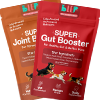
On joints, good nutrition supports joint health and keeps bodyweight in check, and joint supplements give targeted support for preventive care. BLEP's SUPER Joint Booster at ₹599 for the 60g pack contains glucosamine, chondroitin, collagen peptide type II, MSM, green-lipped mussel extract, boswellia, curcumin, and hyaluronic acid, formulated as complementary support alongside a complete diet. If your dog is showing stiffness, limping, or reluctance on stairs, get a vet check too for complete clarity on its condition.
Joint care for dogs: when to start goes into the timing.
What to avoid at every stage
- Calcium supplements on top of a complete diet, particularly during growth
- Free-choice feeding for any large breed at any age
- High-filler formulas where corn gluten, soy, or unnamed cereal derivatives sit in the first few ingredients
- Portioning by eye rather than by weight, which is where most slow weight gain begins
- Treating "large breed" on a pack as a regulated claim, since the term itself is not standardised and the ingredient panel is what tells you anything
Find your breed's guide
Breed-specific considerations sit on top of the size-based ones above:
For older dogs across all of these, the senior dog food range applies, and breed-linked health patterns are covered in common dog breed health issues in India.
Lean beats everything else you can buy
Across all three stages, the intervention with the best evidence behind it is not an ingredient or a supplement. It is a measured portion and a dog you can feel the ribs on.
That is a habit rather than a purchase, applies at every age, and in the Labrador study bought nearly two extra years.
If you want a starting portion for your dog's breed, weight, and age, the diet calculator will size it, and you can reach our pet nutritionist over WhatsApp through our contact page.
Frequently Asked Questions
At what age is a large breed considered adult?
Typically 18 to 24 months, later than the 10 to 12 months common in small breeds. Skeletal maturity, not birthday count, is what marks the transition.
Do large breeds need joint supplements?
Nutrition and body condition come first, and the evidence for keeping a dog lean is stronger than the evidence for any supplement. A joint supplement can sit alongside that as complementary support, ideally discussed with your vet, particularly for a dog already showing signs.
Is human-grade food suitable for large breeds?
Yes. Ingredient quality is not size-dependent. What changes with size is portioning, calcium control during growth, and how closely body condition is tracked.
Can one food take a large breed from puppy to senior?
Yes, if it is a complete food formulated to meet all life stages, including the calcium ceiling that large-size growth needs. What changes across the stages is mostly the amount rather than the food itself: more frequent, growth-appropriate portions as a puppy, steady measured meals as an adult, and a calorie trim as a senior.
How many meals a day does a large breed need?
Two for most adults. Puppies usually need three to four, reducing as they mature. Splitting meals also avoids one very large meal sitting in the stomach at once.
My large-breed dog seems always hungry. Am I underfeeding?
Appetite is a poor guide in breeds bred for it, Labradors especially. Body condition and weight trend are the reliable measures. If both look right, the amount is right.
Resources
- Kealy et al., Effects of diet restriction on life span and age-related changes in dogs, JAVMA, 2002: the 1.8-year median lifespan difference in 48 Labradors
-
Smith et al., Lifelong diet restriction and radiographic evidence of osteoarthritis of the hip joint in dogs, JAVMA, 2006: delayed onset and reduced severity of hip osteoarthritis
Looking to explore more tips on how to look after your furry friend? Check out our other guides like Can Dogs Eat Apples?, Can Dogs Eat Blueberries?, Dog Food for Weight Loss, Raw v/s cooked meat for dogs, Home Remedies to cure tick fever, Finding Good Dog Food in India, How many times should I feed my dog?, Things you should do to keep your pet healthy, Types of Dog Food, How Prebiotics and Probiotics can improve your dog's digestion, Essential Tips for a New Dog Parent, and others. Each guide is designed to help you make better food and care choices for your dog, to keep them happy, healthy, and thriving.